
The cryptocurrency market moves through perpetual cycles driven by attention, liquidity, and structural evolution. For several consecutive market waves, hyper-speculative retail capital was overwhelmingly absorbed by viral tokens and community-driven memecoins on high-throughput networks like Solana and Base. However, as the industry matures and regulatory frameworks solidify, smart capital is orchestrating a massive structural rotation.
When evaluating the market away from pure attention-economy hype, the defining question for investors and builders becomes: What’s the next big crypto narrative after memecoins?
The consensus and underlying data point to a profound maturation phase: the pivot toward institutional-grade Real-World Assets (RWA), autonomous AI agents, Decentralized Physical Infrastructure Networks (DePIN), and ubiquitous stablecoin settlement rails.
1. Macro Context & Market Shift Dashboard
To understand where liquidity is migrating, we must evaluate how market focus is transitioning from ephemeral hype to measurable on-chain utility and institutional backing.
| Emerging Narrative | Core Technological Driver | Current Market Scale & Data Metric | Key Focus for Builders & Capital |
| Real-World Assets (RWA) | Tokenized treasuries, private credit, funds | $23.6B – $27.5B total value on-chain (up ~66% year-to-date) | Bridging TradFi yields with transparent ledgers |
| Autonomous AI Agents | On-chain execution, LLMs, machine learning | Multi-thousand percent category growth; extensive VC backing | Autonomous smart contract execution & portfolio management |
| DePIN & Decentralized Compute | GPU sharing, wireless networks, distributed storage | $9B – $10B sector market cap; real revenue generation | Fueling physical infrastructure demands for modern AI scaling |
| Stablecoin Infrastructure | Global cross-border settlement & instant rails | Approaching $300 Billion total market capitalization | Low-friction international payments & machine cash flow |
Deep Dive: The AI Agent Narrative & On-Chain Autonomous Economies
While memecoins relied exclusively on viral loops and social sentiment, the next major technological frontier marries community distribution with autonomous on-chain utility via AI agents.
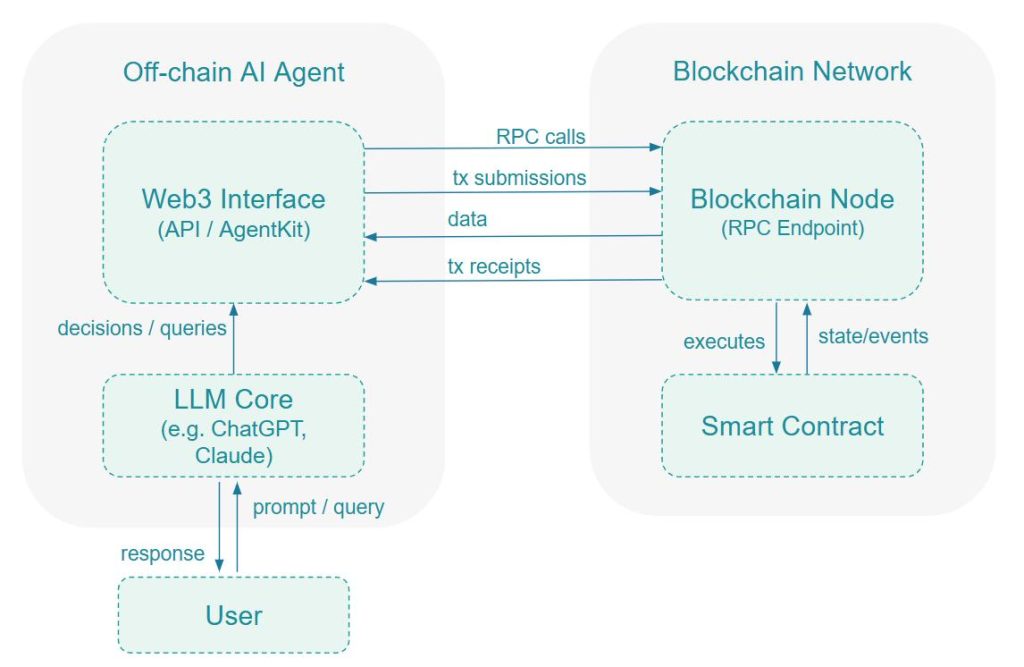


Core Architecture & Mechanics
Unlike static chat interfaces, crypto-native AI agents can execute transactions directly on-chain, manage multi-sig treasury allocations, perform automated cross-DEX arbitrage, and pay for data or API calls using stablecoins. These systems rely on trusted data inputs (oracles like Chainlink), decentralized compute, and wallet-native execution permissions.
Real Project Case Studies
- Virtuals Protocol ($VIRTUAL): A leading platform enabling the co-ownership, monetization, and deployment of AI agents across gaming, entertainment, and interactive social environments.
- Artificial Superintelligence Alliance ($FET / $ASI): A collective unifying decentralized machine learning protocols to build open-source, permissionless AI agent economies.
- Bittensor ($TAO): A decentralized intelligence network that rewards machine learning models, acting as a foundational backbone for distributed AI development.
Deep Dive: DePIN (Decentralized Physical Infrastructure Networks)
DePIN represents one of the few crypto categories characterized by physical infrastructure, external paying customers, and measurable utility rather than purely speculative token issuance.
Core Architecture & Mechanics
DePIN networks leverage token incentives to bootstrap physical hardware deployment—ranging from wireless routers and vehicle dashcams to high-performance GPUs. Instead of relying on centralized cloud providers, applications rent compute or data capacity directly from decentralized node operators.
Real Project Case Studies
Akash Network ($AKT): A decentralized cloud computing marketplace holding high GPU utilization rates for enterprise-grade workloads.
Render Network ($RENDER): The leading decentralized GPU rendering and AI compute provider, generating significant monthly revenue ($38M+) by coordinating global GPU owners for 3D rendering and machine learning workloads.
Helium ($HNT / $MOBILE): A massive wireless and telecommunications network spanning over 900,000 active hotspots and servicing over 120,000 mobile subscribers with carrier-grade infrastructure integration.
Real-World Assets (RWA): Wall Street’s Blockchain Gateway


AI


Narrative Evaluation Framework
To prevent chasing hollow marketing hypes disguised as cutting-edge narratives, professional allocators evaluate projects using a strict 4-Pillar Evaluation Framework:
- Revenue-to-Emission Ratio ($R/E$): Does the protocol generate organic revenue from external customers (e.g., enterprise GPU renters, telecom users), or are yields funded solely by inflationary token emissions?
- Autonomous Execution Security: For AI agent platforms, what are the strict boundaries of smart contract permissions, and how do they prevent prompt injection or hallucination-driven asset loss?
- Physical-World Moat (DePIN): Can the network scale cheaper and faster than centralized alternatives (AWS, Google Cloud) without sacrificing network reliability?
- Institutional Interoperability: Does the protocol bridge traditional financial infrastructure (RWA, banking rails) or remain trapped within isolated crypto-native loops?
5. Comprehensive Risk Analysis
Transitioning from memecoins to utility-driven narratives introduces complex operational and structural risks:
- Smart Contract & Execution Risk: AI agents interacting autonomously with smart contracts can compound bugs or execute erroneous arbitrage loops at machine speed, resulting in instant capital loss.
- Hardware & Depreciation Risk (DePIN): Node operators face heavy upfront equipment costs (e.g., high-end GPUs, specialized sensors) that may face rapid technological obsolescence or shifting network reward allocations.
- Regulatory Compliance Overhang: As AI and tokenized assets intersect with traditional finance, regulatory scrutiny regarding data privacy, automated financial advice, and cross-border securities laws will intensify.
- Token Dilution & Speculative Fatigue: Projects that launch utility tokens without strict fee-burn mechanisms or structural value accrual often suffer from heavy insider unlocking pressure and long-term price erosion.
6. References & Data Sources
| Source Title / Publisher | Focus & Context | Direct Link / Reference URL |
| Blockchain Council: Top AI Agent Crypto Coins Set | Comprehensive 2026 guide on AI agent infrastructure, oracles, and execution tools | Blockchain Council Guide |
| Altrady: DePIN Explained (2026 Trader’s Guide) | Market cap data ($9-10B), revenue metrics, and hardware analysis for DePIN | Altrady DePIN Analysis |
| Mudrex Learn: The Biggest Crypto Narratives in 2026 | Analysis of AI training costs, decentralized compute, and stablecoin growth | Mudrex Learn Report |
| InvestaX: RWA Tokenization Market Report | Data-driven breakdown of tokenized U.S. Treasuries and $27.5B Q1 market cap | InvestaX Research Blog |
| Kucoin Blog: AI Agents vs. LLMs in Crypto Analysis | Evaluation of Token Metrics and AI narrative detection agents in 2026 | Kucoin Blog Insights |
Financial Risk Disclosure: Digital assets, tokens, AI-driven automation protocols, and decentralized physical infrastructure networks carry significant regulatory, counterparty, and market volatility risks. This article is published strictly for educational and informational purposes and does not constitute formal financial, legal, or investment advice. Always conduct thorough independent research (DYOR) before allocating capital.